Our product

/ Case study / Procurement software

Procurement and inventory software for businesses that buy across many sites

Bollard is Safock's own procurement and inventory software for operators who buy for many sites at once. It carries every order from request to approval, purchase order, delivery and invoice match, and records each step in an audit trail that cannot be edited. We built it to close five specific gaps where money leaks out of multi-site purchasing.

Client
Bollard
Industry
Procurement and inventory for multi-site operators
Stack
Web platformDatabase-enforced controlsAppend-only audit trail

What it includes

  • AI assistant on live data
  • Database-enforced controls
  • Append-only audit trail
  • Three-way invoice match
  • Spend approval workflows
  • Multi-site stock transfers
usebollard.com
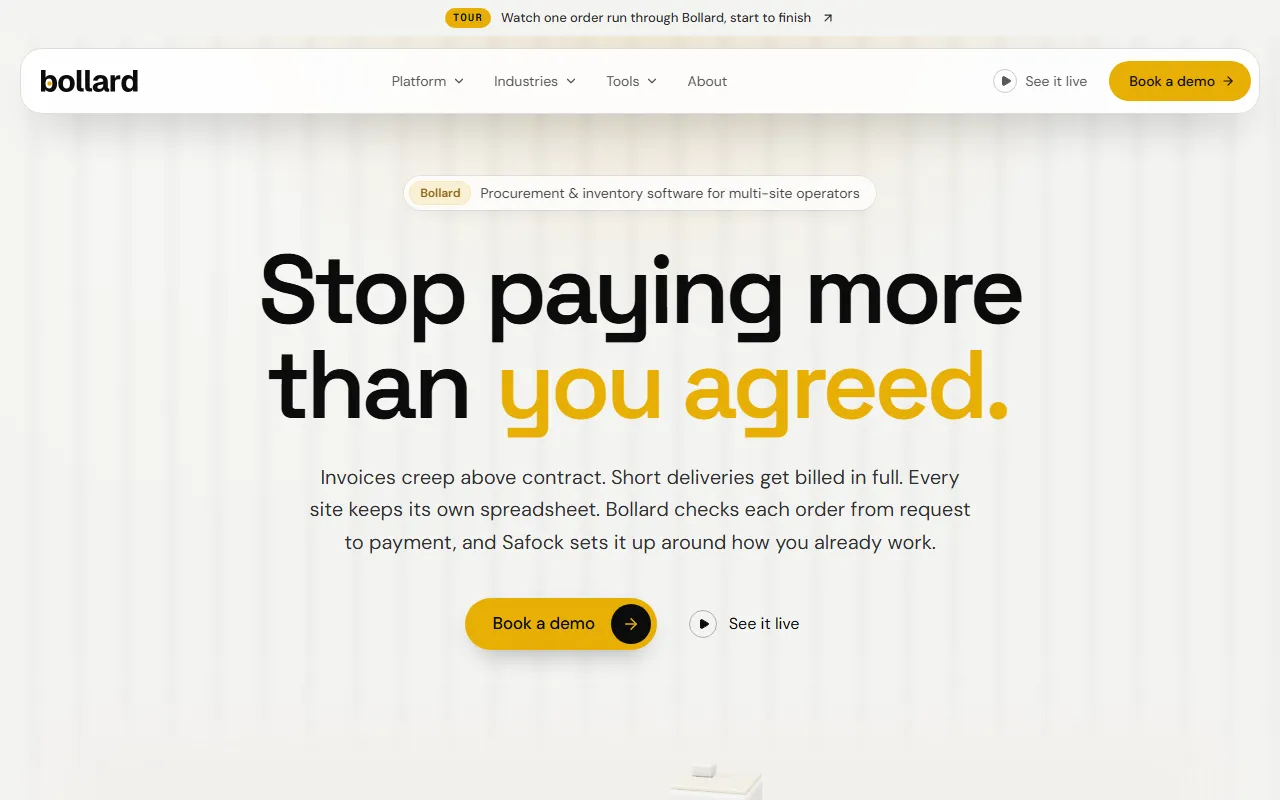
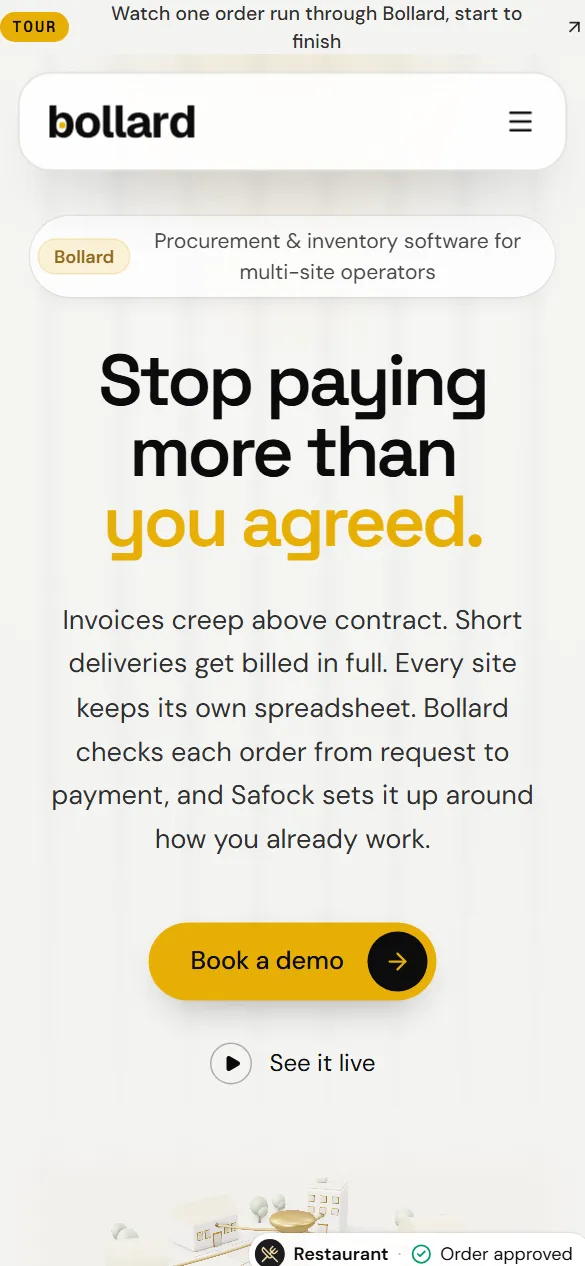
The Bollard website at usebollard.com, presenting procurement and inventory software for multi-site operators

/ At a glance

  • 01Seven platform modulesFrom requisition to audit trail
  • 0214 daysPath to a first live siteDiscovery, import, then a pilot site
  • 03Five industries it is built for
  • 04One audit trail that cannot be editedAppend-only by design
On this page
  1. 01Five places money leaks when every site buys for itself
  2. 02One controlled path from request to payment
  3. 03How the procurement and inventory software maps to each leak
  4. 04Controls enforced in the database, below the screens
  5. 05An AI assistant that respects each user's access
  6. 06A 14-day path to the first live site
  7. 07Built for five industries that buy across many locations
  8. 08What Bollard gives a multi-site operator

01The challenge

Five places money leaks when every site buys for itself

A school group, a clinic network or a contract caterer can run many sites and still buy like a set of separate businesses. Each site has its own suppliers, its own habits and, often, its own spreadsheet. Head office tends to see the spend after the invoices are paid, when it is too late to question any of it.

Bollard is designed around five leaks that show up again and again in multi-site purchasing:

  1. 01

    Sites buy on their own, with nobody approving the spend first.

  2. 02

    Suppliers bill above the price that was agreed.

  3. 03

    Suppliers bill for goods that never arrived.

  4. 04

    Each site keeps its own spreadsheet, so there is no single record of what was ordered, received or paid.

  5. 05

    Stock builds up at one site while another runs short, and nobody sees the imbalance in time.

None of these looks dramatic on a single invoice. Across every site and every month, they add up.


02The solution

One controlled path from request to payment

Bollard puts every purchase through the same sequence, whichever site raises it. A site asks for what it needs and the right person approves it. A purchase order goes to the supplier, the site records what arrived, and the supplier's invoice is checked against both before anyone pays.

That sequence is split across seven modules. Between them they cover all five leaks, and they give head office one record of spend and stock for the whole network.

  1. 01

    RequisitionsSites request goods inside the system instead of calling a supplier directly.

  2. 02

    Approval workflowsEach request goes to the person who signs off on that spend before it becomes an order.

  3. 03

    Purchase ordersOrders go to suppliers at the agreed price, so the price is on record before the invoice arrives.

  4. 04

    Goods receivingThe site records what was delivered against the order.

  5. 05

    Three-way matchThe purchase order, the delivery record and the invoice are compared before payment.

  6. 06

    Inventory and transfersStock is tracked per site, and surplus at one site can move to another on the record.

  7. 07

    Audit trailEvery action is written to an append-only log that nobody can edit or delete.

03How it works

How the procurement and inventory software maps to each leak

Each module exists because of a specific way money goes missing.

Three-way match is a long-established finance control. Comparing the order, the receipt and the invoice catches price and quantity mismatches before payment, when they are still easy to dispute, instead of months later in an audit.

  1. 01

    Sites buying on their owna purchase needs a requisition and an approval before it can reach a supplier.

  2. 02

    Billed above the agreed pricethe purchase order fixes the price, and the three-way match flags any invoice that differs from it.

  3. 03

    Billed for goods that never camegoods receiving records what arrived, and the match flags an invoice for items the site has not received.

  4. 04

    A spreadsheet per siteevery site works in the same system, so orders, deliveries and invoices live in one place.

  5. 05

    Stock imbalances between sitesinventory is visible per site, and transfers move stock between sites with a record of each move.

04How it works

Controls enforced in the database, below the screens

Plenty of business software checks its rules in the user interface. If a screen hides the approve button from the wrong person, the rule holds only as long as every screen, import and integration remembers to hide it too.

Bollard enforces its controls in the database. A rule set there applies to every request, whichever path that request takes to the data. A bug in a form, or a new integration added next year, cannot quietly route around a control.

The audit trail works on the same principle. It is append-only, so entries can be added and never changed. When a finance lead asks who approved an order, at what price, and when the goods were received, the answer comes from a record that nobody could have edited after the fact.

05How it works

An AI assistant that respects each user's access

Bollard includes an assistant that takes questions in plain language, such as which invoices failed the match this month or what is below reorder level at a site. It answers from the live data in Bollard, so a manager gets the current position without building a report.

The assistant shows each person only what their role is allowed to see. Asking a question gives nobody a route around the access they already have.

06How it works

A 14-day path to the first live site

Bollard goes live at one site first, then across the network. The plan for that first site runs over 14 days.

Starting with a single site keeps the change small and visible. The pilot team finds the gaps in the catalog and the approval rules before every other site depends on them. How fast the rest of the network follows depends on the number of sites and the state of the item and supplier data, which we assess during discovery.

  1. 01

    Days 1 to 3, discoveryWe learn how the business buys today, who approves what, and which sites and suppliers are involved.

  2. 02

    Days 4 to 7, catalog and vendor importThe items the business buys and the suppliers it buys from are loaded into Bollard.

  3. 03

    Days 8 to 14, pilot site go-liveOne site runs its purchasing through Bollard from request to payment.

  4. 04

    After day 14, network rolloutThe remaining sites move over, using the setup refined at the pilot.

07How it works

Built for five industries that buy across many locations

Bollard is designed for operators whose purchasing decisions happen at the site while the budget and the accountability sit at head office. Five industries share that split:

  • Education
  • Food service and contract dining
  • Healthcare clinic networks
  • Specialty retail
  • Civil construction

08The outcome

What Bollard gives a multi-site operator

This is a product case study. It covers what we built, why, and how it rolls out. It makes no claims about customer results.

For an operations or finance lead, the design means one place to see what every site requested, what was approved, what arrived and what was paid. Price and delivery mismatches surface before payment. Stock sitting idle at one site is visible to the sites that need it, and every step sits on a record that cannot be rewritten.

The same habits carry into the custom purchasing and approval systems Safock builds for clients. Controls go where the data lives, and one site goes live before the rest.

/ FAQ

About this project

How long does it take to get our first site live on Bollard?

The rollout plan takes a first site live in 14 days. Days 1 to 3 are discovery, days 4 to 7 import your catalog and vendors, and days 8 to 14 take one pilot site live. The rest of the network follows the pilot, at a pace set by the number of sites and how clean your item and supplier data is.

What does it mean that Bollard's controls are enforced in the database?

The rules are checked where the data is stored, below the application screens. A request that arrives through an import or another integration meets the same rule as one made in the app. That holds up far better than checks that live only in the user interface.

Can Safock build a custom purchasing system instead of using Bollard?

Yes. If your approval chains or systems need something Bollard's seven modules do not cover, we build custom software around them. Cost and timeline depend on scope, and we give a fixed quote after discovery. You own the code and receive full documentation.

/ Next step

Want Bollard running in your operation?

Tell us what you are working on. You will speak with a founder, and you will leave the call with a clear next step, even if that step is not us.

Prefer writing? Send us a brief and a founder will reply.

WhatsApp usBook a call